Today's big news is Thaksin's return. The plane made a special stop outside the VIP lounge of the airport for the man who is charged with - and has strong evidence of - corruption.
The biggest non shock is that he was granted bail on both charges. Who would ever have thought?
Events in the past year have gone something like this.
1) Thaksin and Privy Council head Prem have a public war of words.
2) The coup.
3) Prem refers to Thaksin as "evil" or various other unflattering terms at every opportunity, mixed in with his usual nationalist rhetoric.
4) Thaksin says he wants to "make amends" with Prem.
5) Thaksin's wife returns home and gets bail.
6) Thaksin's wife consults a "respectable senior figure" over the formation of a new government (h/t Bangkok Pundit)
6) Thaksin returns home and gets bail.
Go figure.
Incidentally, do not be fooled by Surapong's request to Thaksin to be a "economical advisor". This is a ploy so that Thaksin can make a very public refusal and this will be held up as proof that he truly does not want to return to politics.
Showing posts with label Thaksin. Show all posts
Showing posts with label Thaksin. Show all posts
Thursday, February 28, 2008

Wednesday, January 23, 2008
The fallout
Potjamon Shinwat pleads not guilty and tells the court:
"The defence requests 90 days to gather evidence and await the readiness of the codefendant to jointly fight the charges, expected some time in May"
You could be forgiven for wondering why Potjamon didn't do that during her stalling of months and months when due to testify to the AEC, when these charges were first raised.
Potjamon also confirmed Thaksin will return in May and The Nation suggests Thaksin wants to become a monk.
This wouldn' t be the first time a controversial Thai PM/dictator returned as a monk. It also isn't the first time that politicians have suddenly become remarkably relaxed about corruption charges following requested "reconciliation" meetings with Prem. In the case in question, the former CNS chief also assures us that there were no meetings between himself and Potjamon. The press just made it up.
"The defence requests 90 days to gather evidence and await the readiness of the codefendant to jointly fight the charges, expected some time in May"
You could be forgiven for wondering why Potjamon didn't do that during her stalling of months and months when due to testify to the AEC, when these charges were first raised.
Potjamon also confirmed Thaksin will return in May and The Nation suggests Thaksin wants to become a monk.
This wouldn' t be the first time a controversial Thai PM/dictator returned as a monk. It also isn't the first time that politicians have suddenly become remarkably relaxed about corruption charges following requested "reconciliation" meetings with Prem. In the case in question, the former CNS chief also assures us that there were no meetings between himself and Potjamon. The press just made it up.
Saturday, November 3, 2007
The Economist has a decent piece about "Thaksin the Indestructible". However, I think TE are overlooking the fact that a third player will not allow Thaksin to return. Also, the army will use military force if necessary to ensure he stays out. Thaksin's only hope is that compared to those who want him out, he is young and he can wait.
Tuesday, September 4, 2007
The debate on Thaksin, income gaps and PAD motivation
One of the latest and more interesting debates on the Thailand blog scene has been concerning the reduction in income gaps during Thailand's Thaksin years and the possible resentment of this by the PAD and Bangkok's anti Thaksin middle class groups.
The latest bout of debate was sparked by myself on bangkokpundit's article titled "Thaksin in a nutshell". Blogger Jotman posted a comment suggesting:
To which I somewhat hastily replied:
Now, unlike some other bloggers I know, Bangkokpundit is devilishly detailed and will not accept polemics or a wikipedia scan. He ran a blog "Thaksin and income equality" which appeared to show I was wrong. There is some evidence to suggest that the middle class and rural poor income gap did close during the regime of Thaksin , but it is tenuous and in no way points to PAD motivation for protests.
I suggest reading the blog here. Now let's look in this with some more scrutiny.
First, pundit gives us four pieces of evidence to suggest Isaan workers gained on Bangkokians under the Thaksin regime. (Actually he gives five charts but he does not analyse the final one).
The first two charts are based on the Gini coefficient system. Pundit has already offered a quick definition:
Keep an eye on that bold text. We will return to it.
The next piece of information was a chart showing poverty rates by region in Thailand, and the final chart was a World Bank report showing average income by region as a fraction of Bangkok income. I printed the chart and (without markers) I took a "best case scenario" of a seven percent gain by the north east on Bangkok.
So, it appears that on paper at least, there has indeed been some closure in the income gap, which is good news for anyone who believes in fairness. But we need to ask: just how accurate is this data and how much of this was the TRT government responsible for? And did the issue really cause resentment in Bangkok?
Actual salaries and their change
First, let's drop ratios and look at what this actually means in baht terms. Nearly every economical report from the TRT years tells us that a typical Thaksin voter in demographical terms (i.e. a rural Isaan worker) would have a monthly salary of four thousand baht.
Meanwhile, a typical PAD activist probably fits the description of my wife: a middle class office worker from Bangkok. The average salary for this demographical sector varies more by individual reports but thirteen thousand baht per month is a balanced figure.
So, if we use these two salary figures and trace the gap closure as given in the world bank report, the salary gain by Isaan farmers on Bangkokians is 910 baht.
Remember, this is a best case scenario. It also does not account for inflation. If we take the inflation rate of 3.5 % from the start to the finish of Thaksin's reign, that amount in real terms becomes even smaller.
Trends before and after Thaksin takes the helm
Now let us move on to some other data. Remember that many (not just Pundit, Jotman and Fonzi or the other Thaksin apologists in the blogosphere) have pointed to the reduction in numbers below the poverty line as a result of Thaksin's "war on poverty". Any reduction in poverty is great news, but it's worth noting that this has been a massive trend that was in place well before the reign of TRT. Let's take a look at this graph and commentary from a World Bank siteresources report.

 Source: worldbank.org
Sorry the chart won't come out clearly but it the blue section represents Isaan and the years go from 1988 to 2002 in two years steps. So it tells us....
So it seems this was a trend well in force before the millennium. However there is another interesting factoid in this report. While the poverty count was dropping, productivity was also decreasing:
As I have said before and will repeat later, I think the idea that Bangkokians staged anti-government protests out of resentment is audacious and insulting. However, let me return an equally ludicrous and based on circumstantial evidence idea: Bangkok and the middle classes took to the streets in protest because Isaan workers were seeing an increase in wages even when their productivity was dropping! Bangkokians felt this was unfair and wanted to see people rewarded for their work rate! How's that for an equally preposterous and silly theory?
Now it's time to examine another important topic and a concern that has weighed on me for this whole debate:
Validity of the data.
There are three concerns here. Firstly, how are the salaries being measured? Many farm workers don't have an official salary. They either get cash in hand or simply shelter and food. This report (the same as the one previously quoted) tells us:
There are several ways to interpret these comments and they are not accompanied by graphical data. However, it raises a crucial question: how did Thailand or the World Bank collate this data? Is it taken from a census? If so, how did the census measure undeclared income? It seems very likely that a lot of salaries paid in Isaan are informal and undeclared (to a greater proportion than Bangkok).
If the data was not census data, was it collected by government figures or the BOT? If so can we put personal views aside and simply accept that a government that sold itself strongly on aiding the poor may have vested interests in use of wealth data collected from the area?
It seems possible that the data collated is taken purely from declared salaries. Declared salaries are likely to be higher than those undeclared and the proportion of undeclared salaries in Isaan is likely to be higher than Bangkok. Thus, we could be missing a substantial set of data in this equation.
And yet, we still have not touched on another crucial factor:
Household debt.
Household debts have been raising steadily in Thailand , however the jump from 2002 (Thaksin's first full year) at 84,603 baht to 130,881 baht in 2003 was well above a yearly average. (Pasuk and Baker 2004, The Nation 2004).
Such figures could be cause for alarm. Yunyong Thaicharoen, Kiatipong Ariyapruchya, Thitima Chucherd produced an excellent paper called ."Rising Thai Household Debt: Assessing Risks and Policy Implications" which , initially, puts our mind at rest. Data from part three tells us that farm workers are the only group not to have seen an increase in household debt from 2002-2004.
Of course this risk cannot be directly attributed to Thaksin, but it would surely be fair to say that excess should not be encouraged in a group that are at risk. However, Pasuk Phongpaichit in her paper "Financing Thaksinomics" confirms that Thaksin diverted a huge amount of credit to the agricultural workers. In addition to agrarian debt moratoriums, we also have the Million Baht Village fund, low end consumers goods such as subsidised computers and the People's Bank loan scheme.
 Source: chula.ac.th (Dr Pasuk)
Looking at this quasi fiscal expenditure (i.e. money spent from state coffers ) we can see SME loans (for small businesses) People's Bank (credit for those in low income gaps) , Community enterprise loans and homes for the poor.
At this point, please recall the Gini coefficient for Asia is based on expenditure. Millions upon millions of baht was spent from state coffers in quasi-fiscal financing for expenditure in Isaan and other rural areas! What this means is that while expenditure by Isaan citizens may have increased , it did so due to huge state lending and quasi - fiscal financing. This increases the risk of financial shock on the borrowers in the event of interest rates being increased. And as noted by both Baker and the Thaicharoen, Ariyapruchya and Chucherd team, Thai interest rates are at their lowest for years and cannot be sustained at such a low level.
In conclusion
It appears that Thaksin Shiniwatra and TRT did indeed take steps to close the income gap between the rural poor of north east Thailand and the middle class wage earners primarily based in Bangkok. However, Thaksin was not a miracle worker and the actual tangible increase in wealth by the rural workers was less than one thousand baht in real terms and was depreciated by inflation.
Household debts in Isaan have increased in line with the rest of Thailand, however the burden appears to be greater for this group and their risk has been increased tremendously by lax spending with quasi fiscal funding by the previous government.
It is unlikely that Bangkok's middle classes took to the streets in protest at a decrease in salary gaps.
The latest bout of debate was sparked by myself on bangkokpundit's article titled "Thaksin in a nutshell". Blogger Jotman posted a comment suggesting:
Thailand had made great progress in reversing income inequality. That this is one legacy of the policies of deposed Thai Prime Minister Thaksin, there can be little doubt. I wonder whether the trend also might help to explain why certain segments of Thai society strongly supported the coup d'etat. I have long suspected this. Perhaps noticing that the poor were quickly "catching up," there was some level of resentment on the part of better educated, middle class Thais.
To which I somewhat hastily replied:
I think the idea that "income gaps" were closing is grade A BS. It's another fabrication by apologists for the crook. The average wage did not increase for the rural folk under Thaksin. They were given debt relief, discounts on consumer good and bribes to vote. They did not get an increase in their farming salary.
I think you will find most middle class Thais disliked Thaksin because:
a)He was corrupt
b)He was arrogant almost beyond sane levels.
c)He put his family friends and own business ahead anyone or anything else.
Now, unlike some other bloggers I know, Bangkokpundit is devilishly detailed and will not accept polemics or a wikipedia scan. He ran a blog "Thaksin and income equality" which appeared to show I was wrong. There is some evidence to suggest that the middle class and rural poor income gap did close during the regime of Thaksin , but it is tenuous and in no way points to PAD motivation for protests.
I suggest reading the blog here. Now let's look in this with some more scrutiny.
First, pundit gives us four pieces of evidence to suggest Isaan workers gained on Bangkokians under the Thaksin regime. (Actually he gives five charts but he does not analyse the final one).
The first two charts are based on the Gini coefficient system. Pundit has already offered a quick definition:
The Gini coefficient is a measure of inequality of income distribution or inequality of wealth distribution.
Gini coefficients in Latin America are based on income; those in Asia are mainly based on expenditure, because reliable income data are often not available
Keep an eye on that bold text. We will return to it.
The next piece of information was a chart showing poverty rates by region in Thailand, and the final chart was a World Bank report showing average income by region as a fraction of Bangkok income. I printed the chart and (without markers) I took a "best case scenario" of a seven percent gain by the north east on Bangkok.
So, it appears that on paper at least, there has indeed been some closure in the income gap, which is good news for anyone who believes in fairness. But we need to ask: just how accurate is this data and how much of this was the TRT government responsible for? And did the issue really cause resentment in Bangkok?
Actual salaries and their change
First, let's drop ratios and look at what this actually means in baht terms. Nearly every economical report from the TRT years tells us that a typical Thaksin voter in demographical terms (i.e. a rural Isaan worker) would have a monthly salary of four thousand baht.
Meanwhile, a typical PAD activist probably fits the description of my wife: a middle class office worker from Bangkok. The average salary for this demographical sector varies more by individual reports but thirteen thousand baht per month is a balanced figure.
So, if we use these two salary figures and trace the gap closure as given in the world bank report, the salary gain by Isaan farmers on Bangkokians is 910 baht.
Remember, this is a best case scenario. It also does not account for inflation. If we take the inflation rate of 3.5 % from the start to the finish of Thaksin's reign, that amount in real terms becomes even smaller.
Trends before and after Thaksin takes the helm
Now let us move on to some other data. Remember that many (not just Pundit, Jotman and Fonzi or the other Thaksin apologists in the blogosphere) have pointed to the reduction in numbers below the poverty line as a result of Thaksin's "war on poverty". Any reduction in poverty is great news, but it's worth noting that this has been a massive trend that was in place well before the reign of TRT. Let's take a look at this graph and commentary from a World Bank siteresources report.
 Source: worldbank.org
Sorry the chart won't come out clearly but it the blue section represents Isaan and the years go from 1988 to 2002 in two years steps. So it tells us....
The poverty headcount fell from 48 percent in 1988 to 17 percent in 2002,
and in spite of population growth, the number of poor dropped from 9 million to 4 million people.
So it seems this was a trend well in force before the millennium. However there is another interesting factoid in this report. While the poverty count was dropping, productivity was also decreasing:
Economic growth, while decent by international standards, lacks behind Thailandu-s other regions. Since 1970, annual economic growth fell short by one percentage point compared to the national average, and the Northeastu-s contribution to Thailandu-s GDP fell from 16 percent to only 9 percent even though the population share remained constant at around one third.
The main factor behind lower economic growth is weak productivity gains. Much of the Northeastu-s human, physical and natural resources are absorbed in low-yielding activities. In 2004, the Northeast worker generated only one sixth of the value added of the average worker in Bangkok, Central, East and Vicinity, and just over two-thirds of the output of a worker in the North. And the gap to other regions is rising. Since 1990, labor productivity growth in the Northeast fell short by 0.4 percent compared to the North, by 0.5 compared to Thailand, and by a remarkable 7.7 percent compared to the East
As I have said before and will repeat later, I think the idea that Bangkokians staged anti-government protests out of resentment is audacious and insulting. However, let me return an equally ludicrous and based on circumstantial evidence idea: Bangkok and the middle classes took to the streets in protest because Isaan workers were seeing an increase in wages even when their productivity was dropping! Bangkokians felt this was unfair and wanted to see people rewarded for their work rate! How's that for an equally preposterous and silly theory?
Now it's time to examine another important topic and a concern that has weighed on me for this whole debate:
Validity of the data.
There are three concerns here. Firstly, how are the salaries being measured? Many farm workers don't have an official salary. They either get cash in hand or simply shelter and food. This report (the same as the one previously quoted) tells us:
Less than two fifths of Northeast workers earned a wage at the age of 35, and just over one fifth earned a monthly wage. This compares to two thirds and one half in Bangkok, respectively. These differences in wage employment rates link back to occupation and education, as wage employment is more common outside of agriculture and among skilled workers.
There are several ways to interpret these comments and they are not accompanied by graphical data. However, it raises a crucial question: how did Thailand or the World Bank collate this data? Is it taken from a census? If so, how did the census measure undeclared income? It seems very likely that a lot of salaries paid in Isaan are informal and undeclared (to a greater proportion than Bangkok).
If the data was not census data, was it collected by government figures or the BOT? If so can we put personal views aside and simply accept that a government that sold itself strongly on aiding the poor may have vested interests in use of wealth data collected from the area?
It seems possible that the data collated is taken purely from declared salaries. Declared salaries are likely to be higher than those undeclared and the proportion of undeclared salaries in Isaan is likely to be higher than Bangkok. Thus, we could be missing a substantial set of data in this equation.
And yet, we still have not touched on another crucial factor:
Household debt.
Household debts have been raising steadily in Thailand , however the jump from 2002 (Thaksin's first full year) at 84,603 baht to 130,881 baht in 2003 was well above a yearly average. (Pasuk and Baker 2004, The Nation 2004).
Such figures could be cause for alarm. Yunyong Thaicharoen, Kiatipong Ariyapruchya, Thitima Chucherd produced an excellent paper called ."Rising Thai Household Debt: Assessing Risks and Policy Implications" which , initially, puts our mind at rest. Data from part three tells us that farm workers are the only group not to have seen an increase in household debt from 2002-2004.
But things get worse from there on in many respects. Further data confirms that north east residents have the highest percentage who feel their debts are a "heavy burden". Worse still, the agricultural group appear to be at highest risk: Source:bot.org (Authors named above)
OK So the charts don't appear to be happy about my cut and paste technique. But what this chart tells us is: Source:bot.org (Authors named above)
Two groups of households that perhaps are potentially more susceptible to over
optimism in income prospects is the farmer and labourer in the agricultural sector. A deeper look at the agricultural sector indicates a dissonance between cyclical trends and farmers' expectations. Over the past few years, farm income has risen markedly as a result of favourable price trends in major crops.[Did Thaksin have an effect on crop prices?] In 2002, farm income has grown considerably. Given recent favourable income growth and assurances from the government, these farmers may have increased their borrowing. The figure 4.15 on farm expectations reveals that a substantial portion of farmers in the rice, rubber, and sugarcane sectors expect prices to rise. These farmers may be particularly at risk of over-borrowing and debt stress if they have overly optimistic projections of their income path
Of course this risk cannot be directly attributed to Thaksin, but it would surely be fair to say that excess should not be encouraged in a group that are at risk. However, Pasuk Phongpaichit in her paper "Financing Thaksinomics" confirms that Thaksin diverted a huge amount of credit to the agricultural workers. In addition to agrarian debt moratoriums, we also have the Million Baht Village fund, low end consumers goods such as subsidised computers and the People's Bank loan scheme.
The most concerning statistic of all however is:
Quasi-Fiscal Activities 2002--3
(million baht)
Quasi-Fiscal Activities 2002--3
(million baht)
 Source: chula.ac.th (Dr Pasuk)
At this point, please recall the Gini coefficient for Asia is based on expenditure. Millions upon millions of baht was spent from state coffers in quasi-fiscal financing for expenditure in Isaan and other rural areas! What this means is that while expenditure by Isaan citizens may have increased , it did so due to huge state lending and quasi - fiscal financing. This increases the risk of financial shock on the borrowers in the event of interest rates being increased. And as noted by both Baker and the Thaicharoen, Ariyapruchya and Chucherd team, Thai interest rates are at their lowest for years and cannot be sustained at such a low level.
In conclusion
It appears that Thaksin Shiniwatra and TRT did indeed take steps to close the income gap between the rural poor of north east Thailand and the middle class wage earners primarily based in Bangkok. However, Thaksin was not a miracle worker and the actual tangible increase in wealth by the rural workers was less than one thousand baht in real terms and was depreciated by inflation.
Household debts in Isaan have increased in line with the rest of Thailand, however the burden appears to be greater for this group and their risk has been increased tremendously by lax spending with quasi fiscal funding by the previous government.
It is unlikely that Bangkok's middle classes took to the streets in protest at a decrease in salary gaps.
Friday, July 27, 2007
Welcome to truethaksin watch.......
Truethaksin has been launched.
It contains a load of nonsense, badly written propaganda designed to sway the uninformed international audience. Hence the reason there is an English version.
Over the next few weeks, I'll be dissecting each and every page of this nonsense.
Stay tuned......and may crooks get all they deserve.
It contains a load of nonsense, badly written propaganda designed to sway the uninformed international audience. Hence the reason there is an English version.
Over the next few weeks, I'll be dissecting each and every page of this nonsense.
Stay tuned......and may crooks get all they deserve.
Wednesday, June 27, 2007
Open letter to my MP regarding Thaksin
Dear Mr Denham,
I am a native of Southampton SO19 and now a long term resident of Thailand, where I have been working as a Social Studies teacher in a well known school for one year. I have voted Labour in the past two elections and, in fact, I plan to run for local election myself on my return.
Mr Denham, as a member of your constituency and also a member of a Thai family I would like to register my serious concern on the arrival and business transactions of Thaksin Shinwatra in England.
As you are no doubt aware, Thaksin was ousted in a bloodless coup last year. I am aware that Mr Shinwatra has referred to this undemocratic manoeuvre several times in the English press in an effort to assert his innocence. This is simply not the case.
Thaksin Shinwatra is currently under investigation by a non military, non partisan panel of investigators for numerous alleged acts of corruption involving himself and his family. Nearly all of these alleged offences were reported well before the coup took place. Prosecutors are currently assembling documentary, circumstantial and eyewitness evidence in preparation for a court hearing on several cases.
Mr Thaksin was also subject to a great number of complaints concerning human rights during his "War on drugs" campaign. During this time, a great number of deaths occurred in the country, many of them in highly suspicious circumstances. None of the deaths were investigated during Mr Thaksin's regime.
Finally, Mr Thaksin imposed great pressure on the free press during his tenure as PM. The country's only independent TV station was bought out by a Thaksin business with several critical reporters sacked. English language press came under threats and proxy take over bids, and many radio stations were closed down.
It is true that the prosecutions for corruption are coming indirectly from a non elected junta. However, many charges would have been made already if it were not for the fact that sections of the press, the senate, the judiciary and nearly every independent checking body had come under the influence of Mr Thaksin and his now defunct Thai Rak Thai party during his regime.
TheThai DSI has already confirmed that an extradition order will be made against Mr Thaksin if he does not arrive to hear charges within one month.
I would be happy to provide references to any of the above cited facts at your request.
As I type this, I am informed that AMLO has discovered several sizeable bank accounts in the name of Mr Thaksin in England. He has already been accused of - and denied - illegally channeling money out of Thailand.
Mr Denham, I understand that your right honourable friend David Taylor has already raised this issue in Parliament. As a Southampton Itchen constituent, I would humbly request that the issue of Mr Thaksin and his presence in England is raised again, with the question being : a) Is this truly the kind of guest we welcome in England? and b) Can we pledge to the authorities in Thailand that Mr Thaksin will be extradited if a formal request is made?
I thank you for your kind attention to this matter. Thank you for your work on behalf of the people of Southampton.
Yours sincerely ,
(name)
(UK address supplied)
I am a native of Southampton SO19 and now a long term resident of Thailand, where I have been working as a Social Studies teacher in a well known school for one year. I have voted Labour in the past two elections and, in fact, I plan to run for local election myself on my return.
Mr Denham, as a member of your constituency and also a member of a Thai family I would like to register my serious concern on the arrival and business transactions of Thaksin Shinwatra in England.
As you are no doubt aware, Thaksin was ousted in a bloodless coup last year. I am aware that Mr Shinwatra has referred to this undemocratic manoeuvre several times in the English press in an effort to assert his innocence. This is simply not the case.
Thaksin Shinwatra is currently under investigation by a non military, non partisan panel of investigators for numerous alleged acts of corruption involving himself and his family. Nearly all of these alleged offences were reported well before the coup took place. Prosecutors are currently assembling documentary, circumstantial and eyewitness evidence in preparation for a court hearing on several cases.
Mr Thaksin was also subject to a great number of complaints concerning human rights during his "War on drugs" campaign. During this time, a great number of deaths occurred in the country, many of them in highly suspicious circumstances. None of the deaths were investigated during Mr Thaksin's regime.
Finally, Mr Thaksin imposed great pressure on the free press during his tenure as PM. The country's only independent TV station was bought out by a Thaksin business with several critical reporters sacked. English language press came under threats and proxy take over bids, and many radio stations were closed down.
It is true that the prosecutions for corruption are coming indirectly from a non elected junta. However, many charges would have been made already if it were not for the fact that sections of the press, the senate, the judiciary and nearly every independent checking body had come under the influence of Mr Thaksin and his now defunct Thai Rak Thai party during his regime.
TheThai DSI has already confirmed that an extradition order will be made against Mr Thaksin if he does not arrive to hear charges within one month.
I would be happy to provide references to any of the above cited facts at your request.
As I type this, I am informed that AMLO has discovered several sizeable bank accounts in the name of Mr Thaksin in England. He has already been accused of - and denied - illegally channeling money out of Thailand.
Mr Denham, I understand that your right honourable friend David Taylor has already raised this issue in Parliament. As a Southampton Itchen constituent, I would humbly request that the issue of Mr Thaksin and his presence in England is raised again, with the question being : a) Is this truly the kind of guest we welcome in England? and b) Can we pledge to the authorities in Thailand that Mr Thaksin will be extradited if a formal request is made?
I thank you for your kind attention to this matter. Thank you for your work on behalf of the people of Southampton.
Yours sincerely ,
(name)
(UK address supplied)
Wednesday, June 20, 2007
Published!
The Nation Thailand is one of the two main English language broadsheet newspapers in Thailand. Today, they featured my blog on Thaksin Shiniwat's bid for Manchester City with a picture of my ugly mug and a 'must read' tag on their main web page and even printed a link address to my blog on the front page of the printed edition!!!!
1580 hits so far. In twenty four hours it's garnered more hits than my whole
one year's worth of blogs combined!
This proves one of two things.
Either a) I'm a budding journalist or b) I'm the only foreigner with such a non social life that I actually write about Thai politics.
Still, I'm chuffed!
Permalink : http://blog.nationmultimedia.com/reallifethailand
1580 hits so far. In twenty four hours it's garnered more hits than my whole
one year's worth of blogs combined!
This proves one of two things.
Either a) I'm a budding journalist or b) I'm the only foreigner with such a non social life that I actually write about Thai politics.
Still, I'm chuffed!
Permalink : http://blog.nationmultimedia.com/reallifethailand
Wednesday, May 16, 2007
Political football
No sooner had my own footballing heart been ripped out by Southampton beating Derby on the night only to lose on penalties in the CCC play offs, then The Nation Thailand reports that Thaksin Shiniwat is closing in on a take over of Manchester City football club. Reports state Thaksin enjoyed a VIP tour of the club and 'due diligence' is close to being completed.
On the face of it, this is just another rich man taking over a football club for fun. Certainly that's what most City fans will see anyway. However, dig a little deeper and a few questions present themselves.
1) Thaksin knows nothing about football and has never shown much interest. Why does he want to do this?
Whilst other tycoons have shown willingness to lose millions, they have been keen supporters of the sport. A few years ago when Thaksin displayed a strong interest in Liverpool FC, he was asked to name his favourite players. Thaksin responded "Owen and Gerrard, but I admire many others". In other words, he could only name two England players, he had no idea of the names of any other players of a team he professed to support and was interested in buying. He couldn't name the goalkeepers (Reyna and Dudek) the other strikers (I think it was Cisse at the time?) or any defenders (Hypia for one).
Likewise, when rumours of a purchase of Fulham were widespread, Thaksin told the press: "I don't want to buy them anymore, they lost again last week" This is the sort of flippant remark one expects from someone who knows nothing about football. The fact that his supposed friend and fellow dubious tycoon Muhammed Al Fayed resisted the bid was not mentioned.
So the purchase of an -admittedly big - club in debt that is facing internal problems by a business man with no interest in football seems a little strange to say the least. It's worth noting that Thaksin's two previous attempts to buy football clubs happened to coincide with negative issues in his government. His blatant lies concerning bird flu were quickly forgotten when the issue of Liverpool purchase came up.
2) Why was Thaksin consulted on team affairs?
It is a pet hate of virtually any football fan when the chairman or owner of the club interferes in first team affairs. Credible reports from England have stated that Thaksin was consulted on the sacking of manager Stuart Pearce from Manchester City, and that Thaksin has stated he "wants a foreign manager". Now, given the facts we have already established regarding Thaksin's utter lack of footballing knowledge - how will the City fans react to his obstreperous comments on first team matters?
From the vantage point of an English fan who is also experienced in Thai politics , I can see an issue here already. Thaksin's remarks are designed to make him look a hero. He is probably aware of the City board looking for a big name foreign manager and he feels that few comments made on "wanting a foreign manager" will ensure that when the big name does arrive, he will be perceived as the hero who bought him in. It's the same tactic the won him so much support in Thailand's impoverished north east.
However, theres a potential culture clash on the horizon. Thaksin is used to making a big show of face and being seen as the man who pulls all the strings. English football fans however, are only too weary of businessmen trying to act like they know more than the manager. If Thaksin opens his mouth too much he will not be seen as the hero or the big boss, he will be seen as meddling in first team affairs, and he will draw strong rebuttals and antagonism from the fans. What's more, he won't be able to manipulate the press like he is used to.
3) How will the CNS react?
However much they try and play it off as "It's not our business " or "we don't care" , make no mistake , the CNS will not be happy about this. When the CNS staged its illegal coup, it justified itself by citing Thaksin's corruption and abuse of power and it very quickly gained the backing of HM The King. So strained have the ancient soldiers been that they were almost too busy to elect themselves as executives at various lucrative companies, award themselves a pay rise of double the permitted rate and censor any website or broadcast that was critical of them.
The junta have attempted to copy Thaksin's every step, such as hiring lobbying groups, launching populist schemes to win favour from the poor and running press campaigns all to no avail. Public approval is dropping daily and Thaksin Shiniwat being welcomes by locals in one of the world's trendiest cities (and in a nation with good relations with Thailand) will have them furrowing at the brow, however petty it may seem. And on that thought.........
4) What happens if Thaksin is sent to jail?
From this side of the world it's been hard for me to gauge just how aware and concerned the city fans are with Thaksin's dubious business dealings and forthcoming charges. The former is unlikely to bother them, Roman Abromvich was so popular with his money at Chelsea that few bothered to ask how the Russian businessmen with several close associates in jail or under charges came by his wealth.
However, it's probably no coincidence that the Assets Scrutiny Committee (see my previous blogs on these guys) confirmed they will press for charges against Thaksin for abuse of power concerning a land purchase while he was PM just a couple of days after the City purchase was disclosed. It's now distinctly possible that Thaksin could be sentenced to jail. What would happen then? Would he be allowed to remain owner of City under English or Thai law? What would the City fans make of it? How much would it cost him to buy his way out?
City fans - the real football fans of Manchester - if you're reading this, these are questions you need to be asking your board. What seems to be another tycoon looking to take a team to the top just for fun is probably too good to be true. Thaksin Shiniwat is not a football fan, he's a politician in exile, and he's currently using City in the mid game of political chess against his own country's military. What's more, the military have the backing of HM The King, they are unlikely to lose.
On the face of it, this is just another rich man taking over a football club for fun. Certainly that's what most City fans will see anyway. However, dig a little deeper and a few questions present themselves.
1) Thaksin knows nothing about football and has never shown much interest. Why does he want to do this?
Whilst other tycoons have shown willingness to lose millions, they have been keen supporters of the sport. A few years ago when Thaksin displayed a strong interest in Liverpool FC, he was asked to name his favourite players. Thaksin responded "Owen and Gerrard, but I admire many others". In other words, he could only name two England players, he had no idea of the names of any other players of a team he professed to support and was interested in buying. He couldn't name the goalkeepers (Reyna and Dudek) the other strikers (I think it was Cisse at the time?) or any defenders (Hypia for one).
Likewise, when rumours of a purchase of Fulham were widespread, Thaksin told the press: "I don't want to buy them anymore, they lost again last week" This is the sort of flippant remark one expects from someone who knows nothing about football. The fact that his supposed friend and fellow dubious tycoon Muhammed Al Fayed resisted the bid was not mentioned.
So the purchase of an -admittedly big - club in debt that is facing internal problems by a business man with no interest in football seems a little strange to say the least. It's worth noting that Thaksin's two previous attempts to buy football clubs happened to coincide with negative issues in his government. His blatant lies concerning bird flu were quickly forgotten when the issue of Liverpool purchase came up.
2) Why was Thaksin consulted on team affairs?
It is a pet hate of virtually any football fan when the chairman or owner of the club interferes in first team affairs. Credible reports from England have stated that Thaksin was consulted on the sacking of manager Stuart Pearce from Manchester City, and that Thaksin has stated he "wants a foreign manager". Now, given the facts we have already established regarding Thaksin's utter lack of footballing knowledge - how will the City fans react to his obstreperous comments on first team matters?
From the vantage point of an English fan who is also experienced in Thai politics , I can see an issue here already. Thaksin's remarks are designed to make him look a hero. He is probably aware of the City board looking for a big name foreign manager and he feels that few comments made on "wanting a foreign manager" will ensure that when the big name does arrive, he will be perceived as the hero who bought him in. It's the same tactic the won him so much support in Thailand's impoverished north east.
However, theres a potential culture clash on the horizon. Thaksin is used to making a big show of face and being seen as the man who pulls all the strings. English football fans however, are only too weary of businessmen trying to act like they know more than the manager. If Thaksin opens his mouth too much he will not be seen as the hero or the big boss, he will be seen as meddling in first team affairs, and he will draw strong rebuttals and antagonism from the fans. What's more, he won't be able to manipulate the press like he is used to.
3) How will the CNS react?
However much they try and play it off as "It's not our business " or "we don't care" , make no mistake , the CNS will not be happy about this. When the CNS staged its illegal coup, it justified itself by citing Thaksin's corruption and abuse of power and it very quickly gained the backing of HM The King. So strained have the ancient soldiers been that they were almost too busy to elect themselves as executives at various lucrative companies, award themselves a pay rise of double the permitted rate and censor any website or broadcast that was critical of them.
The junta have attempted to copy Thaksin's every step, such as hiring lobbying groups, launching populist schemes to win favour from the poor and running press campaigns all to no avail. Public approval is dropping daily and Thaksin Shiniwat being welcomes by locals in one of the world's trendiest cities (and in a nation with good relations with Thailand) will have them furrowing at the brow, however petty it may seem. And on that thought.........
4) What happens if Thaksin is sent to jail?
From this side of the world it's been hard for me to gauge just how aware and concerned the city fans are with Thaksin's dubious business dealings and forthcoming charges. The former is unlikely to bother them, Roman Abromvich was so popular with his money at Chelsea that few bothered to ask how the Russian businessmen with several close associates in jail or under charges came by his wealth.
However, it's probably no coincidence that the Assets Scrutiny Committee (see my previous blogs on these guys) confirmed they will press for charges against Thaksin for abuse of power concerning a land purchase while he was PM just a couple of days after the City purchase was disclosed. It's now distinctly possible that Thaksin could be sentenced to jail. What would happen then? Would he be allowed to remain owner of City under English or Thai law? What would the City fans make of it? How much would it cost him to buy his way out?
City fans - the real football fans of Manchester - if you're reading this, these are questions you need to be asking your board. What seems to be another tycoon looking to take a team to the top just for fun is probably too good to be true. Thaksin Shiniwat is not a football fan, he's a politician in exile, and he's currently using City in the mid game of political chess against his own country's military. What's more, the military have the backing of HM The King, they are unlikely to lose.
Wednesday, May 2, 2007
More potshots
Thank goodness April is over. The hottest month of the year is oppressive. It's not just the heat but the accompanying humidity that can be very difficult to live with. Bizarrely, we have since been bestowed with four days of almost endless rain, something unknown to many locals.
The junta continue to establish their legacy as a real life version of Dad's Army. Sections of the US media have attacked Thailand on intellectual property violations and compulsory licensing. The hidden agenda here related to the fact that Abbott Pharmaceuticals have been antagonised by compulsory licensing to their AIDS drug in Thailand. The fact that CL has lowered the price for HIV afflicted consumers is not of their concern. Abbot, along with a US lobbying firm that includes ousted PM Thaksin amongst their clientele, have launched media tirades from across the pond at the Thai government.
The junta have not responded well. As ever, they project their bungling , nepotism gifted and outmoded image by threatening to take the action Thaksin took moths ago - hiring a PR firm. Other PR tactics include loans to the poor and censoring all marches , rallies and websites that oppose them. Surprise , surprise, these were also Thaksin maneuvers. Every time the junta seem to make fools of themselves, they compound it by taking retaliatory measures identical to those of the man they ousted because he was "bad".
Given Thaksin's recent bid to purchase Manchester City we can only wonder - will the junta respond by sending him to jail for corruption of making a desperate bid for a football club themselves? It may sound pathetic but don't rule it out.
In a related move, PM Surayud - one of the few in charge who still has the respect of most people, has taken the incredibly dangerous move of suggesting amnesty for terrorists and rebels in the south. His exact quote was "amnesty provided they have not broken a criminal law of Thailand" which begs the question: what self respecting terrorist does not break the law? It seems that we have not yet learnt that offering peace to the bloodthirsty is perceived as a sign of weakness. Offering amnesty to killers as far as I am concerned is a sign of surrender.
One reader Abdel sent some very interesting comments on one of my recent blogs concerning Islam. I contacted him and he very kindly agreed to let me blog his comments and respond to them. I also promised Abdel a chance to reply to my own comments. Stay tuned.
The junta continue to establish their legacy as a real life version of Dad's Army. Sections of the US media have attacked Thailand on intellectual property violations and compulsory licensing. The hidden agenda here related to the fact that Abbott Pharmaceuticals have been antagonised by compulsory licensing to their AIDS drug in Thailand. The fact that CL has lowered the price for HIV afflicted consumers is not of their concern. Abbot, along with a US lobbying firm that includes ousted PM Thaksin amongst their clientele, have launched media tirades from across the pond at the Thai government.
The junta have not responded well. As ever, they project their bungling , nepotism gifted and outmoded image by threatening to take the action Thaksin took moths ago - hiring a PR firm. Other PR tactics include loans to the poor and censoring all marches , rallies and websites that oppose them. Surprise , surprise, these were also Thaksin maneuvers. Every time the junta seem to make fools of themselves, they compound it by taking retaliatory measures identical to those of the man they ousted because he was "bad".
Given Thaksin's recent bid to purchase Manchester City we can only wonder - will the junta respond by sending him to jail for corruption of making a desperate bid for a football club themselves? It may sound pathetic but don't rule it out.
In a related move, PM Surayud - one of the few in charge who still has the respect of most people, has taken the incredibly dangerous move of suggesting amnesty for terrorists and rebels in the south. His exact quote was "amnesty provided they have not broken a criminal law of Thailand" which begs the question: what self respecting terrorist does not break the law? It seems that we have not yet learnt that offering peace to the bloodthirsty is perceived as a sign of weakness. Offering amnesty to killers as far as I am concerned is a sign of surrender.
One reader Abdel sent some very interesting comments on one of my recent blogs concerning Islam. I contacted him and he very kindly agreed to let me blog his comments and respond to them. I also promised Abdel a chance to reply to my own comments. Stay tuned.
Friday, February 16, 2007
Confused? I nearly cried
A quick lesson in Thai politics
Never been to
OK, So there was this guy Thaksin. Clever, very good businessman but utterly cold, manipulative, devious and highly superstitious. Naturally, he formed a political party of people just like him. He got so bad that there was a coup (possibly with an order from someone even higher than the PM) and in came the coup leader General Sondhi who installed Surayud (ex trooper) as interim PM.
Sondhi quickly explained they staged the coup due to a) Rampant corruption b) National disunity and c) Economic dangers from capitalism. Sondhi and Surayud both explained they would switch to a "sufficiency economy".
You following so far? Good, this is what happened next…..
Surayud installed a cabinet. It was a decent line up but it was true “old ginger” the average age being about two hundred and five. The junta also installed a corruption investigation team, and a very able one at that. Sadly, they forgot to stop every single one of Thaksin’s henchmen from hiding evidence and intimidating witnesses. Also the old boys in government realized that a) Things had changed since they were last in command and b) Nobody could actually explain their new "sufficiency" theory. It was all a bit of a pickle, and something needed to be done….
Still OK so far? OK brace yourself for the last paragraph…….
So, the junta had a great plan, they employed Thaksin’s right hand man and finance minister Somkid Jatusripita to explain sufficiency economy and counter Thaksin’s propaganda. That's right, they got one of the really bad men that they removed in a coup to explain why they removed the bad men in the coup. They took one of the greedy capitalists to explain why they were rejecting greedy capitalism. They employed one of the men under investigation for patronage in a rubber saplings scandal by the AEC to explain the corruption in the previous government. What’s more they were happy about it.
You got all that? Good. How's your head?
The spat with
Readers of my previous article on
Once again, it all seemed to be dying down until suddenly General Sondhi made a stupid and bizarre remark to the public.
Clearly Mr. Sondhi is on some kind of propaganda for his own means here. With comments about “patriotism” “nation building” and “sacrifice for the good of the country” it can only mean they are after something that involves manipulation of the national psyche. Watch this space.
Friday, January 26, 2007
A battle for Thai hearts


Now I'm breaking my own vow not to discuss politics on here but I am going to try and make this as relevant and light as possible.
Thaksin Shiniwatra went on CNN last week and cunningly portrayed himself as the innocent, democratically elected leader removed by a greedy military coup.
It was the latest episode in a mental warfare so subliminal it almost feels like a real life rendition of the old "Tron" movie. This time however , the enemies consist of an adroit but utterly corrupt and cold politician with his cronies on one side and an aging, outmoded but powerful military junta on the other.
Thaksin followed up this propaganda effort by travelling to Japan and telling the awaiting press "I am disgusted with the media interference" , referring to the fact that the military junta censored his previous CNN display in Thailand.
Anybody with rudimentary knowledge of Thai politics watching the CNN interview could be forgiven with sympathising with Thaksin's cause. These people would be misguided. Thaksin is a master of mental warfare and subtle intimidation, and the fact that he is a weak public speaker who stumbles at English only enhances his feigned innocent demeanour.
Rather than launch a tirade of rebuttals , I will try to list some precise facts here:
1) Thaksin took corruption in Thailand to unprecedented levels. When he took office - after lobbying judges to forgive him for blatant asset concealment - he told the people "I do not need to be corrupt, I am already rich" (He neglected to mention he was already rich from using contacts to win government concessions and alleged insider trading to avoid the Asian crash of 1997). The day after taking office , Thaksin launched decrees to put mobile phone competitors out of business and never looked back. His family became the richest in Thailand by (ab)using their power to eliminate all forms of competition. It would take a book to list his alleged misdeeds.
The junta have installed a hand picked team known as the Assets Scrutiny Committee (also known as the Assets Examination Committee) to investigate corruption. They have been criticised for being slow but they are trying to do things lawfully, and incriminating a team of powerful and devious crooks is not easy.
2) Thaksin had no respect for law whatsoever. The law major and former police captain packed and lobbied every independent body to allow himself free passage of action. The Election Commission, the National Counter Corruption Commission and of course the police force was headed by hand picked men sycophantic to Thaksin. Various charges were bought against TRT MPs but could reach no conclusion as the reponsible bodies would simply throw all cases out. The opposition parties had so few MPs in the house that 'no confidence' debates were a forgone conclusion. TRT MPs who wanted to keep their little piece of the greedy pie knew what they had to do in such situations. During the debate on the airport CTX scanner scandal (scanners were sold at a 20% greater than invoice price and the US trader admitted paying kickbacks) one female TRT MP Pattra Waramit actually dared to abstain rather than vote for her party colleague, stating she could not support him with a clear conscience. The masters degree holder Waramit was escorted to a meeting room from where she emerged crying and said: "I'm sorry, I was tired and pressed the wrong button". These actions came from the same people who were being paid massive salaries to run the country.
(For yet more quotes from Waramit and her father who is also a TRT MP , click here. The quotes give an excellent insight into politics, especially the quote "he hoped she had learned something about politics")
3) Thaksin was sickeningly arrogant and unrepentant. He had a clever populist line of rhetoric that turned any criticism or complaint against him to a complaint against Thailand , a ploy that worked well on the rural masses that formed his main support base.

A few select quotes are:
On taking office:
"I will serve twenty full terms and then retire out of sympathy to the opposition. There will be no crime, no Mafia and no social ills"
In response to academic criticism:
"I have full knowledge of democratic values, those who know less should refrain from talking"
" Some teachers cannot teach and just criticize to look cool. They will have to go".
On concerns about compramisation of independent checking bodies:
"The woman who cautions me is my wife. People needn't worry, my wife keeps me in check"
(Two points of note here: Firstly, Thaksin didn't mention that since he took office, his wife had become the richest woman in Thailand and was heavily implicated in tax evasion allegations. Secondly, this quote was made not longer after HM The King had made a speech in which he mentioned how his mother used to keep his feet on the ground. I wonder if Thaksin simply liked the sound of HM The King's speech).
Talking to the rural masses about the protests in Bangkok:
"These people think they are smarter than you, you must tell them loudly how you feel"
After losing two by - elections:
[to the voters in those two provinces] "Let me be very clear, we will take care of our own first, we will give priority to those provinces who voted for us"
(NB Thaksin seemed unconcerned that he was publicly declaring a breech of constitutional rule by showing favour to provinces that voted for him)
Now watch for a trend from here on............
After protests against the government decision to privatise public businesses without referendum and sell them to politician shareholders:
"Some people don't understand what we are doing because they don't have enough knowledge"
During protests against Thaksin using public funds to buy Liverpool Football Club:
"Some people simply don't understand. They aren't ready for my vision yet"
"Some people might be upset because they don't have access to all the information"
After the Constitutional Court rejected Thaksin's bid to privatise the Electric Authority:
"Some people are confused and don't understand, that's OK"
"Some people might not be aware of all the facts"
After massive Bangkok protests in response to Thaksin selling his main business and avoiding paying tax:
"There are technical issues that most people don't understand so they are confused"
A second standard response was to state that any critic of any form "doesn't love the country"
4) Last but not least , Thaksin was involved in huge scale media intimidation. I could write another ten pages about all of this, but I've waffled enough already. Suffice to say that this letter from today's edition of The Nation provides a nice summary:
Ex-PM getting a taste of how his regime dealt with media
Re: "No plans to return yet, says Thaksin", News, January 24.
I must confess I fully sympathised with ousted prime minister Thaksin when he said "I am outraged at the interference to the mass media", this week.
Of course, he was referring to the censorship of his recent CNN interview. However, I was also shocked when, during the time of his regime, a total of 32 reporters quit ITV after alleged government interference with programming. Likewise, I was disgusted when radio stations that happened to be critical of the prime minister disappeared from the airwaves. I reeled with horror when the English-language newspapers became victims of various threats, clandestine investigations and buyout attempts as they dared to cast a critical eye at the Thai Rak Thai Party. And I was stunned when one single journalist was struck with an extortionate damages claim for venturing to suggest Thaksin's family businesses had profited from his tenure as premier. Indeed, one must fully sympathise with Thaksin because media intrusion is indeed a major sin, and one that should not go unpunished.
A Father in Thailand
I could go on but I think you get the picture. Thaksin isn't a wolf in sheep's clothing , a more accurate description came from academic Thirayuth Boonmi who described Thaksin as a "monstrous baby".
Nobody likes a coup, it is an unforgivable sin. But in the case of Thailand - as I have written before - the country was in grave danger of a class war or at least a unbridgeable gulf between the Bangkokians with a new generation of university students and an educated workforce who opposed Thaksin, and the rural masses, subject to populism and manipulation, prone to sporadic bursts of violence and given taxpayers money to parade their support of Thaksin.
General Sondhi is set to appear on CNN next week to give the other side of the view.
The future look cautious. A new constitution is in progress, the government has promised police reform and elections within a year , bomb investigations are underway and already the army and police are contradicting and opposing each other. But while the ASC seeks to uncover solid evidence to convict the Thaksin family, the man himself is circling Thailand like a hawk. His screeches cause the aging junta to act rashly, bureaucracy to procrastinate ASC investigations through fear of reprisals and the Thaksin supporters to continue their resentment of the new regime.
One can only hope that all the rifts are healed, justice is served and the country moves forward. Ultimately it will be down to the Thais themselves, and those in power must have the courage and the love to do what is best for the country and its populace, rather than serving themselves and their own selfish narrow minded greed and ideas.
Monday, January 1, 2007
The world sings, Bangkok weeps.

The news spread so quickly in the era of the global village. Within minutes of the events people were texting me asking questions. I wasn't able to tell them much they didn't already know though, given the nature of the events and the authorities dealing with them. Bangkok was in a state of confusion.
Now things are a little clearer. In the build up to midnight on December 31st a series of bombs exploded within minutes of each other. The bombs were strategically placed to maximise both their profile and number of potential victims. The first explosion was at Victory Monument - not only an important symbol for Bangkok but also a central transport hub - this was followed by an explosion at the large urban area known as Klong Toey. This explosion was planted in a spirit house, which would be a major superstitious deterrent for almost any Thai. Undoubtedly the most important blow for the attackers was the explosion outside Central World Trade, the department store that acts as the focus for the annual new year's party.

News reporters struggled to keep up with the whirlwind of events though, unbelievably, some channels continued with their normal programme schedule. As reports of the first death came in and causalities increased, Bangkok governor Apirak Kosayothin stepped up at Central World Trade to cancel the party. Some revellers continued, apparently unknowing or uncaring that several foreigners and two Thais had been seriously hurt by an explosion from within a phone booth. A bomb at a seafood restaurant nearby also cause major injuries.
Although heavy on military protocol and southern insurgency, the majority of Thais - unlike the British - do not have the misfortune to be familiar with terrorist assaults. Panic ensued. Stores closed, police swarmed the city ( a highly dubious form of 'protection' ) , embassies issued knee jerk "warnings" to prospective visitors. It was all high on fear. The next day many Thais stayed at home, fearing to step into their high street.
But as relative calm ensued, facts came in and the police - aware of the international attention - did their best to look like they had competent investigations underway, the Thai newspapers printed their usual grizzly selection of bloody photos - a morbid yet intriguing insight into the Thai psyche - the TV channels began idle chat shows discussing everything and concluding nothing about the events, government worker Porntip Rojanasunant - a forensics expert treated almost as a celebrity due to her unusual appearance and forward thinking attitude - appeared at the bomb sites. The inevitable aftermath began.
Who was responsible for the attacks?
By all intelligence reports, expert and amateur anlaysis and reasoned ( as is possible for such a tragedy) argument , there are two suspects. However, there are factors pointing two and against both groups:
The southern Muslim insurgents.
This was my first conclusion. The issue of southern insurgency in Thailand is something I've been meaning to write about for some time, but it's a complicated issue. In short, Thailand took some land from Malaysia in the eighteenth century. Since then, ideological militancy has been omnipresent in the region, including a string of bomb attacks on Bangkok in 1980. After 9/11, militancy and terrorist attacks in the region soared, spurred on by gross mismanagement and insensitivity from the Thaksin government., most notably in the notorious Tak Bai incident. Like most Muslim militant groups, the southern separatists seem to have no problem mixing their religious goals with inhuman violence. Monks and teachers have been prime targets of random attacks, and on one occasion a group of one hundred villagers kidnapped two female teachers and beat them into a coma in response to a police arrest of one villager. The teachers were simply chosen at random. PM Surayud has gone to great lengths to heal hurt within the region, however attacks have continued.
There are several points that could suggest southern insurgency involvement in the attacks:
- 1) Simply put, these are people who like to hurt and kill innocents and enjoy violence.
- 2) Intelligence reports had warned of planned attacks by this group.
- 3) Similar attacks in 1980.
- 4) No denial has been issued by any insurgent leaders.
However, there are also points against them:
- 1) It's uncharacteristic. Since the escalation of violence in the south post 9/11, all attacks have been within the southern provinces. Despite vague threats in the past, there have been no attacks in Bangkok or else since 1980.
- 2) Simply put, the southerners are fish out of water in Bangkok. The sprawling metropolis is very different to the sleepy Muslim villages that have raised most of the twisted insurgents. Although Thais have little faith in their security forces, it's unlikely so many ,militant movements by the insurgents could have occurred without some prior warning or capture.
- 3) After forty eight hours of police posing, forensic expert (non police employed) Porntip Rojanasunant has confirmed that the explosives used were different to those normally used by the militants.
- 4) Evidence to an inside job. See below.
Politicians
The other finger of suspicion points to what the government and army call "undercurrents". By this, they mean Thaksin Shinwatra, the ousted PM, his cronies, his family, and the many, many well connected figures that are in his service due to their greed and corruption. Since the September coup, many schools in the north east of Thailand - Thaksin's stronghold - have been hit by arson attacks. A campaign to discredit new PM Surayad was undertaken, and various other clandestine movements have been in action. These have been relatively well quashed by the Junta.
Evidence for the "undercurrents" is as follows:
- 1) Evidence of inside work. PM Surayud , General Sondhi and Thailand's police chief have suggested that the attacks seemed pre meditated.The attacks at a police box Samphan Kwai should have been captured on CCTV , however the camera was inexplicably cut before the attack. Undisclosed details of other evidence for an inside attacks is held by authorities.
- 2) As mentioned, the weaponry used was dissimilar to that used by insurgents and included army issue explosives.
- 3) Organisation. Most insurgent attacks have been messy, brutal and spontaneous. The attacks in Bangkok were well sequenced.
There are also points against the case for "undercurrents"
- 1) What would they gain? Though many people wrongly consider that Thaksin and his men are too good or caring to be even knowledgeable of the attacks (Thaksin cares about nothing but money and power) , there seems to be nothing gained from such attacks except possibly undermining and unsettling the new regime.
- 2) Uncharacteristic. Thaksin's tactics in the past have been more Machiavellian. The style of his government was to financially or characteristically discredit people. Other than the war on drugs and use of thugs to attack protesters, Thaksin's rule was brutal but relatively non - violent.
One more major point to consider here is how quickly the authorities pointed to the "undercurrents" for the blame. It seems very convenient. Thai authorities are known for their inefficiency, lack of training and corruption, yet 48 hours after such attacks all public fingers were pointing at Thaksin and his cohorts. This conclusion helps the new regime to demonise (as if it were needed!) and villanise the old PM as he continues to threaten by his presence alone. It's a most useful propaganda tool for the junta and surely achieves more than "undercurrents" would have done by instigating such attacks.
The mystery is likely to play itself out for some time yet. Thai politics are always dramatic. MP Chuwit has offered one million baht of his own money for any information leading to arrests, Thaksin's lawyer and the TRT party have both issued strong denials of involvement.
Hardly the ideal opening for 2007. After a tumultuous year of coups, protests, sickening southern violence and massive allegations of corruption, Thais are hoping for a better year. Sadly, with this tragedy sitting on top of a dubious national legislative assembly drawing a new constitution and ongoing investigations into corrupt politicians and continuing violence in the south , it may well be another trying year for the good people of Thailand.
For a written timeline of events and discussion about the forwarning of attacks see Bangkok Pundit I often disagree with many of his views but his coverage is excellent.
Friday, November 17, 2006
Cat and mouse: Thaksin torments the Thai government
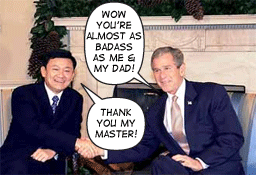
Ousted PM Thaksin Shinawat is playing mind games with his deposers. He’s traveling all around
****************************************
Tomorrow I’m doing a one day visa run to
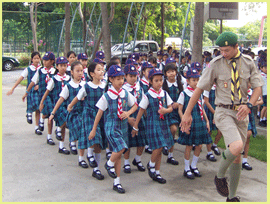
Today – as with every Friday – the students in my school did their marching duties. As part of school discipline procedures, all students (in nearly every school) must stand outside for the national anthem, say a prayer, and work up a sweat by marching. I was walking past the masses of kids as usual when they started doing their chanting. Suddenly I started having flash backs of football matches. Images of Southampton playing Man Utd,
“The Departed” starring Leonardo Di Cpario, Matt Damon, and Jack Nicholson is great. It’s based on a
Subscribe to:
Posts (Atom)